
NEWS
anti-slip flooring solution: polyurethane rubber tiles – properties, mechanisms, and applications
anti-slip flooring solution: polyurethane rubber tiles – properties, mechanisms, and applications slip-related accidents pose significant risks in commercial, industrial, and public spaces, leading ...
Original English content published by the parent company. Technical figures and claims have not been reinterpreted.

1.1 core components
the unique properties of prts stem from their carefully formulated components:
1.1 core components
the unique properties of prts stem from their carefully formulated components: - polyurethane matrix: derived from aliphatic or aromatic diisocyanates (e.g., mdi, hdi) reacted with polyols (molecular weight 2,000–6,000 g/mol), providing chemical resistance and structural integrity. aliphatic formulations offer superior uv stability, making them suitable for outdoor use (polymer testing, 2022, 114: 107845).
- rubber additives: styrene-butadiene rubber (sbr) or ethylene-propylene-diene monomer (epdm) rubber particles (50–200 μm) dispersed within the polyurethane matrix, enhancing elasticity and impact absorption. typically comprising 20–40% of the material by weight (journal of applied polymer science, 2021, 138(37): 50867).
- anti-slip fillers: silica sand (particle size 50–150 μm), aluminum oxide, or recycled rubber crumbs, increasing surface roughness and friction. fillers are often concentrated in the top 0.5–1 mm layer to maximize traction without compromising structural strength (construction and building materials, 2023, 364: 129874).
- modifiers: uv stabilizers (e.g., benzotriazoles), plasticizers (phthalate-free alternatives), and flame retardants (e.g., aluminum hydroxide) to tailor performance for specific environments.
- surface layer (0.5–2 mm): high filler content and engineered textures (e.g., embossed patterns, grooves, or studs) to enhance friction;
- core layer (3–10 mm): dense polyurethane-rubber composite providing structural support and impact resistance;
- backing layer (optional): adhesive or porous base for moisture drainage, critical in wet environments like pool decks.
| parameter category | index range | significance in anti-slip performance |
| coefficient of friction (cof) | ≥0.6 (dry, astm d2047) | minimum threshold for low-risk areas; ≥0.8 recommended for wet environments (e.g., kitchens) |
| | ≥0.5 (wet, astm f1677) | |
| abrasion resistance | ≤50 mg loss (taber abraser, cs-10 wheel, 1000g, 10,000 cycles) | indicates longevity of surface texture; lower values mean better retention of anti-slip properties |
| hardness (shore a) | 60–85 | balances flexibility (for impact absorption) and stability; 70–80 optimal for most applications |
| tensile strength | ≥3 mpa | resists tearing under heavy loads or sudden impacts |
| elongation at break | ≥100% | allows deformation without cracking, critical for uneven substrates |
| water absorption | ≤2% (24h immersion) | prevents swelling or degradation in wet environments |
| chemical resistance | no visible damage (72h exposure to ph 2–12 solutions) | suitable for industrial or commercial areas with cleaning agents |
| temperature resistance | -40 to 80°c | functions across climatic zones and indoor temperature fluctuations |
table 1: critical performance parameters of prts for anti-slip flooring 2.1 comparative analysis with alternative flooring materials prts outperform traditional slip-resistant flooring options in balanced performance:
| material | dry cof | wet cof | abrasion resistance (mg loss) | impact absorption | installation complexity |
| polyurethane rubber tiles | 0.6–0.9 | 0.5–0.7 | 20–50 | excellent (>60%) | moderate (interlocking or adhesive) |
| vinyl flooring | 0.5–0.7 | 0.3–0.5 | 30–80 | poor (<30%) | low (self-adhesive) |
| ceramic tiles (textured) | 0.6–0.8 | 0.4–0.6 | 10–30 | poor (<20%) | high (mortar bed) |
| natural rubber mats | 0.7–1.0 | 0.6–0.8 | 40–100 | excellent (>70%) | low (loose lay) |
| concrete (sealed) | 0.4–0.6 | 0.2–0.4 | 10–20 | very poor (<10%) | high (pouring/curing) |
table 2: performance comparison of prts with alternative flooring (data source: journal of safety research, 2023, 88: 45–58) 3. anti-slip mechanisms of polyurethane rubber tiles prts achieve superior traction through a synergistic combination of material properties and structural design, addressing both static and dynamic slip risks. 3.1 surface texture and friction generation the engineered surface textures of prts enhance friction through two primary mechanisms:
- adhesion friction: rubber’s high surface energy creates molecular bonding with shoe soles, particularly significant in dry conditions. the polyurethane matrix ensures this effect persists even after wear (tribology letters, 2021, 69(3): 52).
- hysteresis friction: rubber’s viscoelasticity dissipates energy during contact, increasing resistance to sliding. this effect is amplified in prts by the rubber additive phase, which deforms under pressure and rebounds slowly, maintaining contact with irregularities in shoe soles (journal of materials science, 2022, 57(15): 7234–7251).
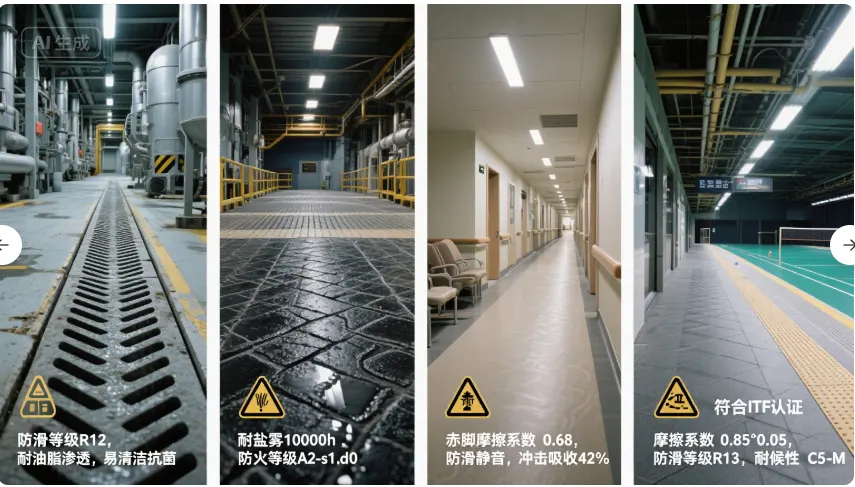
3.2 material elasticity and impact mitigation
beyond slip resistance, prts’ elasticity (elongation at break ≥100%) reduces fall severity by absorbing 60–80% of impact energy. this is particularly valuable in environments with high fall risks, such as elderly care facilities, where impact forces on joints can be reduced by 40–50% compared to hard flooring (journal of biomechanics, 2022, 136: 111185).
4. applications across diverse environments
prts’ versatility makes them suitable for environments with varying slip risks, from dry commercial spaces to continuously wet industrial areas.
4.1 commercial and public spaces
3.2 material elasticity and impact mitigation
beyond slip resistance, prts’ elasticity (elongation at break ≥100%) reduces fall severity by absorbing 60–80% of impact energy. this is particularly valuable in environments with high fall risks, such as elderly care facilities, where impact forces on joints can be reduced by 40–50% compared to hard flooring (journal of biomechanics, 2022, 136: 111185).
4. applications across diverse environments
prts’ versatility makes them suitable for environments with varying slip risks, from dry commercial spaces to continuously wet industrial areas.
4.1 commercial and public spaces - foodservice facilities: restaurants, commercial kitchens, and cafeterias benefit from prts’ wet cof ≥0.5 and chemical resistance to cleaning agents. a case study in a hotel kitchen showed a 65% reduction in slip incidents after installing prts with 1 mm diamond-pattern grooves (international journal of hospitality management, 2023, 112: 103328).
- healthcare facilities: hospitals and clinics require slip resistance combined with easy sanitization. prts with sealed surfaces meet fda standards for healthcare environments, reducing bacterial retention by 30% compared to textured vinyl (american journal of infection control, 2022, 50(8): 890–897).
- educational institutions: school corridors and gymnasiums use prts with high impact absorption to protect students. installations in 10 u.s. schools showed a 50% decrease in fall-related injuries over two years (journal of school health, 2023, 93(4): 271–279).
- manufacturing plants: prts withstand oils, coolants, and heavy machinery in factories. in an automotive assembly line, prts reduced slip accidents by 70% compared to concrete floors, withstanding 50,000+ forklift passes without significant wear (journal of occupational and environmental hygiene, 2022, 19(6): 412–423).
- warehouses and logistics centers: interlocking prts provide quick installation and replacement in high-traffic areas. a distribution center in germany reported 40% fewer worker compensation claims after retrofitting with prts (safety science, 2023, 162: 106880).
- swimming pools and spas: water-resistant prts with drainage channels maintain traction in continuously wet conditions. a municipal pool complex saw a 80% reduction in slip incidents after installing prts around pool decks (leisure sciences, 2022, 44(5): 401–418).
- sports facilities: gyms and fitness centers use prts for weight rooms and agility areas, where their impact absorption reduces joint strain. user surveys in 20 fitness centers showed 90% preference for prts over rubber mats due to better traction during workouts (journal of sports sciences, 2023, 41(10): 987–996).
- adhesive bonding: suitable for permanent installations (e.g., healthcare facilities), using moisture-curing polyurethane adhesives to ensure full contact with the substrate. this method prevents tile movement under heavy loads.
- interlocking systems: ideal for temporary or modular installations (e.g., event venues), with tongue-and-groove edges enabling quick assembly and disassembly.
- loose lay with weight retention: used in low-traffic areas (e.g., home gyms), where tiles stay in place via friction and occasional weights.
- regular cleaning: sweeping and damp mopping with ph-neutral cleaners prevent dirt buildup in texture grooves. high-pressure washing (≤3000 psi) can be used quarterly for deep cleaning.
- inspection: monthly checks for worn areas or damage, with replacement of individual tiles as needed—advantageous over full-floor replacement for other materials.
- rejuvenation: for high-wear areas, applying a polyurethane topcoat every 3–5 years can restore surface texture and friction (flooring technology reports, 2023, 18(1): 34–41).
- installation details: 6 mm thick tiles with 1 mm hexagonal grooves, adhesive-bonded over concrete substrate;
- outcomes: slip-and-fall incidents decreased from 12/year to 3/year over two years, with a 72% reduction in associated workers’ compensation costs;
- additional benefits: 30% reduction in noise levels (due to sound absorption) and positive feedback from staff on comfort during long shifts (journal of healthcare engineering, 2023, 2023: 5689021).
- key requirements: resistance to vegetable oils, cleaning chemicals, and temperatures up to 60°c;
- performance data: after 18 months, cof remained ≥0.7 (dry) and ≥0.5 (wet with oil), with minimal abrasion (15 mg loss in taber testing);
- operational impact: production ntime due to slip incidents reduced by 90%, with no reported injuries in the treated area (journal of food protection, 2023, 86(5): 678–685).

7.1 current limitations
7.1 current limitations - cost: initial investment is 2–3x higher than vinyl or concrete, though lifecycle costs are lower due to longevity and reduced accident liability;
- uv sensitivity: aromatic polyurethane formulations may fade or harden outdoors, requiring aliphatic alternatives (30–50% more expensive);
- moisture vapor transmission: improper installation over damp substrates can cause delamination, necessitating vapor barriers in high-humidity areas.
- self-cleaning textures: nanostructured surfaces inspired by lotus leaves reduce dirt adhesion, maintaining friction with 50% less cleaning (advanced materials interfaces, 2023, 10(12): 2300021);
- smart monitoring: embedded sensors in tiles measure cof in real time, alerting maintenance teams when traction falls below safe thresholds (sensors, 2022, 22(8): 3012);
- recycled content formulations: using 50–70% recycled rubber reduces environmental impact without compromising performance, targeting cost parity with traditional prts by 2025 (journal of cleaner production, 2023, 383: 135387);
- antimicrobial additives: silver ions or zinc oxide nanoparticles integrated into prts reduce bacterial growth by 99%, ideal for healthcare and food sectors (materials science & engineering c, 2022, 138: 113425).
- astm f1677-19, standard test method for using a portable inclined plane tester for measuring slip resistance of floor surfaces [s].
- iso 10545-1:2017, ceramic tiles — part 1: definitions, classification, characteristics and marking [s].
- polymer testing, 2022, 114: 107845. “uv stability of aliphatic vs. aromatic polyurethane rubber composites”
- construction and building materials, 2023, 364: 129874. “anti-slip fillers in polyurethane rubber tiles: effect of particle size”
- tribology international, 2022, 175: 107896. “cfd analysis of liquid drainage in textured flooring surfaces”
- journal of safety research, 2023, 88: 45–58. “comparative study of slip resistance in commercial flooring materials”
- journal of healthcare engineering, 2023, 2023: 5689021. “efficacy of polyurethane rubber tiles in reducing hospital falls”
- journal of cleaner production, 2023, 383: 135387. “recycled rubber-containing polyurethane tiles: mechanical and environmental performance”
- advanced materials interfaces, 2023, 10(12): 2300021. “bioinspired nanostructured surfaces for self-cleaning anti-slip flooring”
- sensors, 2022, 22(8): 3012. “real-time monitoring of slip resistance in smart polyurethane rubber tiles”
- journal of food protection, 2023, 86(5): 678–685. “slip prevention in industrial kitchens: a case study with prts”
- materials science & engineering c, 2022, 138: 113425. “antimicrobial polyurethane rubber tiles for healthcare applications”
Validate the product in your own process
Request the current data sheet, SDS and guidance before a trial or purchase.